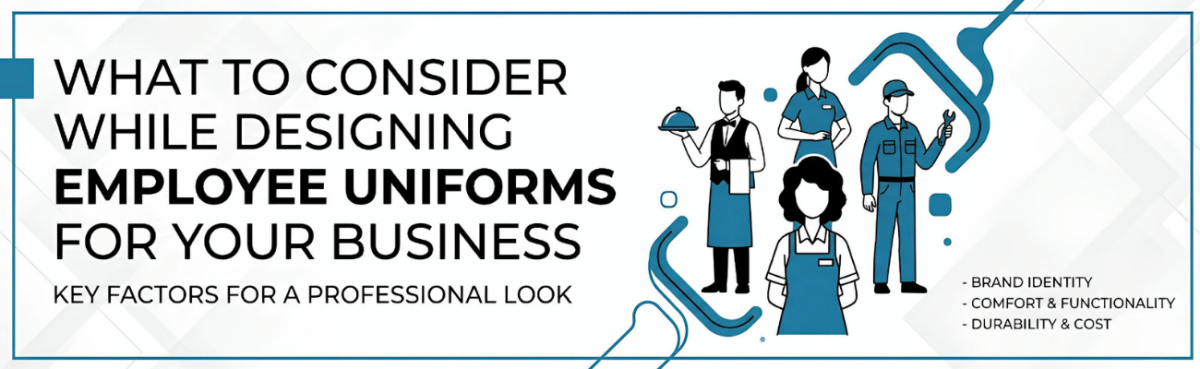
What to Consider While Designing Employee Uniforms for Your Business
Your employees are the most visible extension of your brand. Every interaction and customer touchpoint shapes first impressions—and your team represents that visually every day.
Walk into a hotel, office, retail store, hospital, or manufacturing unit, and one thing becomes clear instantly: people form opinions before anyone speaks. In many cases, first impressions are formed simply by how employees are dressed.
That’s why employee uniform design in India is no longer just about clothing—it’s about branding, comfort, professionalism, and performance working together. A smartly designed uniform can improve customer trust, build team confidence, and create a stronger brand presence.
If you are wondering how to design employee uniforms for business, this guide covers everything you need to know before placing an order.
Why Investing in Employee Uniforms Makes Business Sense
Many businesses still view uniforms as an expense. In reality, they are a long-term operational and branding investment.
Here is what the data shows:
|
Key Insight |
Impact |
|
83% of customers associate professionally dressed staff with higher service quality |
Better customer trust |
|
65% of employees feel more confident when uniforms fit well |
Higher morale |
|
₹12,000 average annual spend per employee in Indian mid-sized companies |
Common industry benchmark |
|
40% reduction in clothing-related decision fatigue |
Better daily efficiency |
These numbers show that a well-planned corporate uniform design strategy can positively affect both employees and customers.
Before You Start: Understand What Makes a Good Corporate Uniform
Before selecting fabrics, colors, or logos, ask one important question:
What should the uniform communicate about your business?
Because the best uniforms do more than look neat. They reflect your brand values.
-
A fintech company may prefer sharp, minimal styles.
-
A hospitality brand may focus on elegance and warmth.
-
A factory or warehouse setup may prioritise durability and safety.
Your uniform should feel like a natural extension of your business identity.
Things to Consider While Designing Employee Uniforms
Now let us move into the most important section, the actual factors to consider in workwear design.
-
Start with Brand Identity and Industry Relevance
The first step in how to design employee uniforms for business is aligning the uniform with your brand image.
Think about your industry, customer expectations, and work environment. A corporate office needs a different look than a restaurant kitchen or logistics team.
Your design should answer:
-
Should employees look formal or approachable?
-
Should the brand appear premium or practical?
-
Is the business customer-facing or backend-focused?
A good uniform speaks before your employee does.
-
Consider the Real Working Environment
One of the biggest mistakes companies make is designing uniforms in isolation.
India’s climate varies drastically, so employee uniform design India must consider temperature, humidity, and daily working conditions.
For example:
-
Outdoor staff need breathable and lightweight fabrics.
-
Office teams may need structured fabrics that hold shape.
-
Industrial workers may require reinforced stitching and safety features.
-
Staff standing for long hours need flexible, movement-friendly fits.
Comfort is not optional. It directly impacts productivity.
-
Fabric Selection Is Where Quality Begins
If there is one factor that decides whether uniforms succeed or fail, it is fabric.
Different workplaces require different materials:
-
Polyester blends: Durable, wrinkle-resistant, easy to wash
-
Cotton-rich fabrics: Breathable, comfortable for warm climates
-
Stretch blends: Better mobility for active roles
-
Flame-resistant or anti-static fabrics: Essential in industrial environments
The right fabric balances comfort, durability, and maintenance.
Many corporate uniform manufacturers in India recommend testing fabrics before full production.
-
Prioritise Fit and Size Inclusivity
Even premium uniforms fail when sizing is poor.
India has highly diverse body types, so standard sizing alone often does not work. Businesses should ensure suppliers offer at least 8–10 size variations, with custom sizing if required.
Why does fit matter?
-
Better comfort during long shifts
-
Higher employee confidence
-
Cleaner, more professional appearance
-
Improved movement and ease of work
A good fit transforms how employees feel at work.
-
Involve Employees Before Finalising Designs
One of the smartest ways to improve acceptance is to ask employees for feedback early.
A 2021 SHRM study found that employees involved in uniform selection were 52% more likely to wear it consistently and with pride.
This can be done through:
-
Wear trials
-
Feedback forms
-
Size testing
-
Colour or style preferences
When employees feel heard, adoption becomes easier.
-
Keep Branding Professional, Not Excessive
Your logo placement matters more than most businesses realise.
-
Chest logos work well for customer-facing teams
-
Back logos improve visibility in dynamic environments
-
Sleeve branding can be subtle and modern
-
Branding method also matters:
-
Embroidery: Premium, durable finish
-
Screen printing: Cost-effective for bulk orders
The goal is visibility with professionalism.
-
Think Long-Term: Maintenance and Replacement Costs
Do not judge uniforms only by upfront price.
A quality uniform generally lasts 18–24 months with regular use. Lower-quality uniforms may fade, lose shape, or tear sooner, increasing replacement costs.
Choose uniforms that are:
-
Machine washable
-
Colourfast (Grade 4 or above)
-
Easy to iron or wrinkle-resistant
-
Durable for repeated use
This creates better long-term value.

Common Mistakes Businesses Should Avoid
Even well-intentioned companies make predictable errors. Avoid these common issues:
-
Choosing fabric based only on price
-
Ignoring employee feedback
-
Selecting catalogue designs unsuited to real work conditions
-
Ordering limited sizes only
-
Ignoring seasonal changes
-
Over-branding the uniform
Working with experienced staff uniform suppliers in India helps avoid these mistakes.
Choosing the Right Uniform Partner
The supplier you choose matters as much as the design itself.
Reliable business uniform suppliers in India partners help with sizing, sampling, fabric testing, scalability, and repeat orders. Established names such as Shri Hosiery have worked across hospitality, corporate, and industrial sectors, where balancing branding with functionality is essential.
When evaluating top uniform manufacturers in India, look for:
-
Customisation ability
-
Fabric quality assurance
-
Size range support
-
Delivery capacity
-
Industry experience
Read Also- Choosing the Right Fabric for School and Corporate Blazers
Conclusion
A strong uniform does more than standardise appearance. It strengthens your brand, improves employee confidence, and creates better customer impressions every day.
If you are planning corporate uniform design or searching for Corporate Uniform Manufacturers in India, start with comfort, function, fit, and brand alignment. That is what truly makes a good corporate uniform.