Why Global Buyers Prefer Indian Uniform Manufacturers
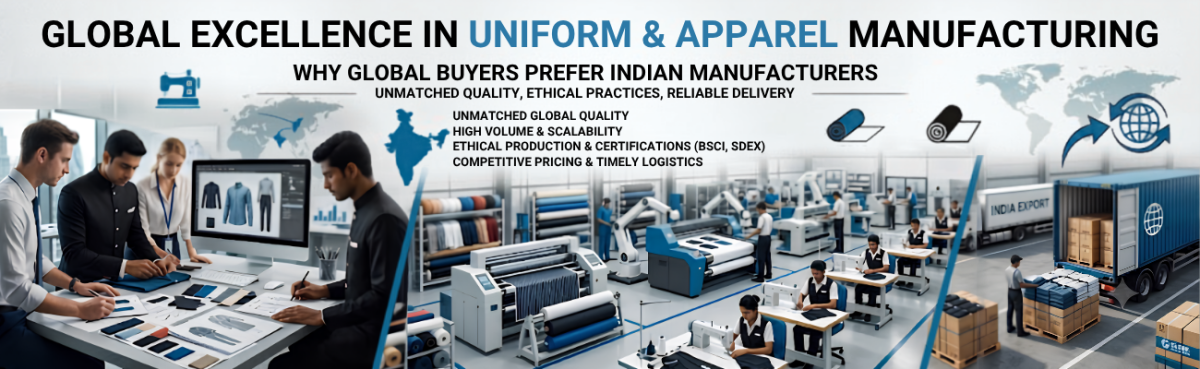
Buyers worldwide are seeking partners who offer predictable quality, timely delivery and intelligent customisation, rather than just price. In the last decade, India has quietly and by design become the supplier of choice for uniforms worldwide, with many businesses now opting out of China. This article shows you why, along with real data points and clear direction for buyers who need export-quality uniforms or a reliable uniform wholesaler.
India vs China: Quality Comparison
But when buyers choose between India and China for dress shirts, three words govern the outcome: fabric quality, stitching finesse, and conformance to international standards.
-
Material quality: Indian mills manufacture all kinds of fabric, from medium- to heavy-weight cotton; poly-viscose blends to light, breathable poly-viscose blends, and many more, which are apt for school/mill/uniforms in hospitals or even corporate ones. Textile mills in India have modernised – most mills now manufacture and supply export-quality uniforms, certified to OEKO-TEX and other international standards.
-
Workmanship: Garment workers in India are highly trained to provide excellent stitching, uniform sizing, and delicate finishing, which help reduce returns and rework. This is vital in bulk uniform manufacturer contracts, as the appearance of uniforms matters across thousands of pieces.
-
Compliance and transparency: Indian suppliers increasingly provide documentation on country of origin, chemical safety, and labour compliance, which is crucial for maintaining uniform supplier relationships globally.
Quick data: The exports for the textile industry in India saw $40+billion worth of exports last year, and uniform (a subsegment) based out of India has been growing every year as brands are starting to circle back to needing more traceability and standards relating to specific types of fabrics.
India's Strength in Textile Manufacturing
What gives India its competitive advantage is an integrated ecosystem — with raw textiles, spinning mills, fabric processing, and garment factories in proximity. It shortens lead times and provides increased quality control for buyers.
-
Dynamic pricing: Labour costs in India are still cheaper (India no longer has low-cost auto), but the actual win is value; clients get enhanced finish and upgradation at an extension of under growth dynamic
-
Government initiatives: "Make in India" has spurred investment in textile technology, enabling Indian factories to install modern production lines and produce export-quality uniforms.
-
Scale and range: India has thousands of suppliers, ranging from small boutique factories that specialise in bespoke custom production to large bulk uniform manufacturers capable of shipping tens of thousands of units.
Also read- Custom vs Ready-Made Uniforms: Which Is Better for Employee Comfort, Branding & Cost?
How Indian Manufacturers Support Custom Uniform Production
Personalisation is now just an expectation. Buyers demand logos, reflective tape, and unique pockets, plus high-durability stitching, all within tight deadlines. To counter the effect, Indian manufacturers have invested in flexible production setups and strong supply chains for trims, threads & accessories.
-
Faster prototyping: With fabric and trim suppliers in the vicinity, samples can be created and changed in days–not weeks.
-
Local textiles: Buyers can specify fabrics with specific GSM (grams per square metre), finishes (for example, anti-crease or other), or certifications (OEKO-TEX).
-
End-of-Service: Several suppliers serve as one-stop shops, from design and sampling to bulk production and export packaging.
Quick comparison - India vs China (Uniform Manufacturing)
|
Feature |
India |
China |
|
Average lead time for custom bulk orders |
6–10 weeks |
8–14 weeks |
|
Local fabric sourcing |
Very high (many mills nearby) |
High, but sometimes imported trims |
|
Compliance & documentation transparency |
Improving rapidly |
Established, but varied by region |
|
Cost for mid-range school uniforms (per unit, FOB) |
Competitive |
Competitive |
|
Flexibility for small-batch customization |
High |
Medium |
|
Typical strengths |
Craftsmanship, customisation, Make in India support |
Large scale, well-established export networks |
How this table helps: It provides procurement teams with a quick overview of trade-offs when choosing a global uniform supplier.
The Future of Uniform Exports from India
The outlook is optimistic. This has made buyers realise the importance of supply-chain resilience and sustainability. India is likely to see considerable growth in uniform exports due to its strengths in local sourcing, expanding compliance frameworks, and government incentives. Get ready for better traceability and faster turnaround times, even on export-standard uniforms labelled ‘Made in India’
Shri Hosiery India - An Overview
Shri Hosiery India is one example of an Indian uniform manufacturer that has scaled its business to +3,500 schools, +1,500 colleges, 100+ corporates, and over 20,000 clients across states over decades, blending scale with quality. With over 40 years of manufacturing expertise, they represent a range of Indian enterprises and advanced production techniques for local and foreign buyers.
Buyers' tips when choosing a Global uniform supplier
-
Ask for full specs: Fabric GSM, composition and any finishing treatments.
-
Request two-stage sampling: a pre-production sample and a pre-shipment sample.
-
Verification of compliance documents: Request labour, safety and chemical compliance certificates
-
Work out the total landed expense: consider unit price, lead time, rework costs, and shipping.
-
Collaborate with the supplier on a pilot order: Test the water with small batches before ramping up.
Would you like a Quote and Sample Pack for your Institution?
Message our team today for a custom quote and a free fabric sample.